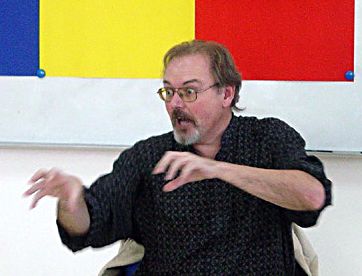
Had a bit of a 'black' few months - hand operation really damped down my enthusiasm to type and ability to concentrate: Over now, just realizing it will never be back to normal and have to live with it.
Should be posting soon.
Saturday, January 05, 2008


Saturday, December 01, 2007
Talking Turkey
Christmas time again - click on the link above for a good start to the festive season!
Thursday, October 04, 2007
Space Age and Power of Babel
I’m trying to decide which is more frightening – the fact that I have just realised I am older than the Space Age (Sputnik was launched only 50 years ago) or the following advert released by Babel, the company I work for!
In case your Romanian isn’t up to it – the punch line is, “Some things sound better in English!”
 timisoara
In case your Romanian isn’t up to it – the punch line is, “Some things sound better in English!”
timisoara
Thursday, September 27, 2007
Falling illusions

Whether it was an intended, "stick it in and twist", or just accidental, I wouldn't like to say -
from someone who I don't particularly like, who I haven't seen for several years, and who i never want to see outside of a coffin again:
"Alan, aren't you getting fat! Don't worry, it comes with old age."
I am going into denial immediately.
Saturday, July 07, 2007
Venus Rising!
Tennis is the best of games - just watch the unstoppable Venus Williams, seeded down in the twenties (you'd have thought the old cruds at Wimbledon would have learnt by now!) and in another final.
There is nothing beautiful in what she does - pure animal power and instinct, and a love of life.
You can tell she values - what doesn't matter, just the holding on to that value system with such force takes her above the ordinary.
You've never won until the last ball in tennis - and you've never lost either: What better model for life?
There is nothing beautiful in what she does - pure animal power and instinct, and a love of life.
You can tell she values - what doesn't matter, just the holding on to that value system with such force takes her above the ordinary.
You've never won until the last ball in tennis - and you've never lost either: What better model for life?
Wednesday, June 13, 2007
Far from bleak!
Sunday afternoons, unless I'm misremembering, were Dickens infested: The T.V. might have been black and white, but the lasting visual memories are peopled with richly coloured characters.
Later, post ‘Civilisation’, Attenborough induced colour came.
But the essential BBCness remained monochrome - a brooding delight in rough, pencil sketched, hard-lined iconography - stretching the ludicrous mask of caricature over the malleable faces of great actors.
There was a Pickwick (Nigel Stock?); a Makawber (Bob Hoskins); a Lady Dedlock (Diana Rigg).
There were fogs, and graveyards, rowing boats and carriages; mud: And rain, dirt, exploitation.
If Dickens reinvented Christmas – then the BBC reinvented Dickens.
What the dickens is it about 'Dickens' that make such great television, and how does the BBC 'do' such great Dickens?
I suspect one aspect is the humour to be found in ‘The Gothic’ – for Dickens, despite his highly valued serious reputation, never lost hold of the quick thrill and the cheap laugh. Good actors can play such stuff for all it is worth.
Like Shakespeare, no matter what weird, intellectual shapes latter generations have twisted the work into, the writer was writing for money, and for a ‘lower-class’ of audience. But neither craftsman patronised that audience – they knew their fortunes lay in entertaining them. However, I fear Shakespeare loved and liked his Groundlings more than Dickens his readership.
Shakespeare had ‘but a short time’ to stuff his ‘seven acts’ into; Dickens had a much longer period – but split into episodes each of which had to, soap-opera-like, cliff hang. Neither writer could luxuriate in a slowly developing character (real time) – although both were able to give impressions of organic-like growth.
Both writers are pre-Freud – their psychology is immediate, not sub-conscious – the only things hidden are from the world, not from the self – people might choose to ignore truths about themselves, but that is the free choice of Protestantism.
As a consequence, we can blame – and there is nothing so entertaining as being able to judge, and preferably condemn, others.
Dickens has also got the journalist’s sense of the newsworthy.
Despite the common belief that the news is factual, it really is just another form of storytelling – and its attraction lies in the power of the news story to describe the disruption an event causes to a perceived normality.
I think this is one of the big differences between Dickens and Shakespeare: Dickens plays against an accepted social norm – The fog caused by the Court of Chancery might be ubiquitous, but it is an aberration, it is unjust; Shakespeare constantly asks, what is justice?
Another, somewhat surprising, difference can be found in Dickens great ability to create a solid environment in which to place his characters: We can honestly talk of ‘Dickens’s World’ – not so Shakespeare. Hamlet belongs not in
And here we come to one major reason for the success of the BBC-Dickens marriage. (And partly the reason for the more disastrous of the BBC Shakespeare.)
The BBC is willing and able to spend money on sets, costume and make-up – and it has the technical skills of a very experienced in-house crew to call upon. The uninformative term, ‘Production Values’ is used to describe this constant. It is not only the willingness of great actors to participate in minor roles that brings success to theses productions.
As technology has developed, the BBC has been quick to apply it to new adaptations of Dickens.
Once the heavy television cameras fixed programmes firmly in the studio – or required the use of much more expensive film cameras.
Now the lightness of equipment and the ease of digital editing, etc. mean the ‘sets’ can frequently be real buildings, real places. In the 2005 Bleak House, Lady Dedlock is truly at home.
But it is not only the solidity of bricks that have benefited from the move in technology - I was struck by the power of the sound picture in the new Bleak House. Not since the BBC Radiophonics Workshop tingled my spine with the Doctor Who theme have I been so ‘worked-on’ by a television soundtrack.
The sound edit is matched by the picture edit – both cleanly modern.
And then there is the direction – risking going over the top and stopping just in time. Another case of young talent being given the space they need?
For that is surely another key to the BBC’s success – the mix of experience and youth.
I have to admit, I don’t really like most Dickens – but every time I watch a BBC adaptation, I have to give the writer another chance – so, off to the bookshop in search of Bleak House.
Tuesday, May 29, 2007
Wild Things!
It's strange, but the only judgement which counts, in the end, is your own.
Over the course of the last year I've withdrawn from several Internet 'discussion groups' because of the combative nature of the 'discussions'.
Shakespeare has been at the centre - and people's interpretations of the work.
The vicious attacks on views which differ from those held by certain individuals resemble the fighting over politics seen on occasions on the t.v.
There is no restraint.
It is almost as if it is an attack on what one thinks about a play - or what one sees in a text - is an attack on one’s identity.
I am not exactly a delicate flower, but I don’t wish to be subjected to abuse from individuals unknown – so, from now on, it’s the Blog and nothing but the Blog!
Thursday, May 10, 2007
Coming Alive
A new life in the country has floored my online experiences for quite a while now.
Slowly coming back into cyberspace but it is going to take time and I suspect a slower more restrained contribution - although outburst likely.
Weather here in Romania been rotten - distinct drought - and never seems to have raised any interest outside the place - minor storms in the US headline news.
Being on the fringe does mean something here - the edge of what though?
Slowly coming back into cyberspace but it is going to take time and I suspect a slower more restrained contribution - although outburst likely.
Weather here in Romania been rotten - distinct drought - and never seems to have raised any interest outside the place - minor storms in the US headline news.
Being on the fringe does mean something here - the edge of what though?
Monday, March 26, 2007
Erkin!

I spent many hours in the company of this young man - teaching English, visiting his parents (for some great food) and getting him to act as my unpaid driver when I wanted to visit different parts of North Cyprus and couldn't get Lutz to take me.
He wanted to be an architect - did he ever make it I wonder?
I came across the photo yesterday as Cris delivered a pile of old diskettes: Goodness knows what else will pop up.
I loved North Cyprus - but am too much of an English Rosebud to take the heat.
Tuesday, March 06, 2007
Winter and Foul Weather

There is distinctly a touch of Spring in the air - so much so that some of the flowers are starting to open and students have started sitting on the benches by the Bega and kissing.
The "fuck-bugs" are also conjoined - a red and black mass on the trunks of trees.
I cannot help thinking it might be a false hope - the waves of repeating wind and storm passing over the Atlantic coast still seem to be there - and although there is a 'high' protecting us, how strongly lodged is it?
I fear for my plums.
Three year's ago we had a great crop - enough to make 30 bottles of tuica (no namby-pamby stuff this - great for flambe - and not even double distilled: Still got one bottle left).
For the last couple of years, no plums - the spring has frosted the flowers and that was the end of it. It even got the Walnuts one year and reduced considerably the crop last year.
Now I am back in the country I hope to produce a significant amount of my food this summer from the land - but let's see what the weather has in mind!
Sunday, February 04, 2007
No Gods: No Masters

Was listening to one of the 'In Our Time' programmes on Radio 4 and got a shock - I thought I knew all about Anarchism - and I don't.
It is one of those concepts you here about rather a lot -indeed, i even read about some of its authorities - and assume you understand, but it turns out you were totally mistaken.
Anarchism is not chaos - which is what most teenagers think it is (and that is the age most people stop thinking about it).
There appears to be a duality in us - an urge for authority and a need for independence - a wish to be ourselves and a dependence on others.
Anarchism is part of the needs and wishes for individuality.
Tracing the 'Anarchist tendencies' back through history it is not surprising to come across the likes of Socrates - and Xeno - in the early threads of the thought.
Nor is it a surprise to find Plato - a product of Socrates - swing against the tendency to produce his Republic - the proto-manual for fascism.
No surprise either in finding Anarchist thoughts amongst the more revolutionary elements in the English Revolution - The Diggers, of course, were soon squashed by the authorities, but not before they left us with 'The World Turned Upside Down'.
But more interesting has been the discovery that I am something of an anarchist myself: My move to Romania, the desire to feed and live on my own away from the borders and restrictions which have impinged on my life, all smell distincly anarchistic to me.
Wednesday, December 27, 2006
Christmas Bookends
Two poems I like to think of as Christmas bookends:
Thomas Hardy's, The Oxen,
and
T.S.Eliot's, A cold coming we had of it.
Why bookends is a little obvious I'm afraid - The Oxen is set on Christmas Eve - or rather, the moment BC turned to AD (to steal from U.A. Fanthorpe) - and the ‘Cold Coming’ is the Epiphany (12th Night, the time when 'Members of an obscure Persian sect' - Fanthorpe again - 'walked into history').
Both have become, like Holly, Christmas Evergreens associated in the minds of my generation of English Teacher - and consequently countless students - with the Christmas Carol Service - (which we still called it back then) - and regular recitations tucked somewhere between 'Away in a Manger' and 'We Three Kings'.
If you had a good, younger student, the Hardy could be given a lovely simpering twist; Eliot needed a teacher to deliver it well - bit of a grumpy ex-PE, now Geography teacher - or a slightly fading girl's heartthrob English staff junior member!
And therein lies the tragedy.
Both poems get stuck on the shelf for the rest of the year (dusted off sometimes for examination) to await another Resurection as a quick fix of emotion amongst the Plastic Glitter, Bugger-the-fire-regulations Candles and Coca-Cola Santas.
Both poems though, like Holly, have a bit more 'history' - and spikes which raise blood.
The first thing I notice, and which I think is frequently ignored, is the ‘quote’ at the start.
“Now they’re on their knees” – an elder said. When was it said? – When we were children.
As children we see the world in a hopeful way – optimistically.
It is a pastoral view – gentle shepherds, gentle oxen.
Good will out.
“ . . . meek mild creatures . . .” make up our world – and nature is dominant.
Hardy is remembering innocence.
It was beautiful; it was honourable: It is dead.
It is, ‘so fair a fancy’ – that few would now weave it. Only a fancy.
It is a time, “childhood used to know”.
In the Eliot, they had a cold coming.
He is quoting doubly – Launcelot Andrews and the old, near to death, Magi.
His memories are not so pleasant, but they are as ideal.
Like the child in Hardy, there is a yearning for that birth – for the glory and beauty of new life.
The reality though is “Hard and bitter agony”.
There is a suggestion of disillusionment.
But it is only a suggestion – there is tremendous hope.
It is the hope of the child, still in the man – “If someone said . . . I should go with him . . .hoping it might be so.”
For Eliot, “All this was a long time ago, I remember,
And I would do it again.”
Once again, that core stone of hope, the ‘no regrets’ of the old man that is in both poems.
What chance I wonder have children of ever understanding these poems?
‘Birth or Death?’
Sunday, December 10, 2006
Wintersmith
At 113 years old, Miss Treason, a witch, knows about the connection between age, beans, fresh fruit and 'letting out wind'!
Tiffany, only 13 years old, with a 'he's not my boyfriend!' (even if he does send her letters with SWALK on them), is learning witchcraft from Miss Treason. She discovers there is lot of hard work, cleaning around the cobwebs and polishing the skulls, chasing after the cheese - called Horace, a rather single-minded blue cheese - oh, and a strange tingling feeling behind the eyes when Miss Treason, who is blind, uses you as a mirror.
Like most teenage girls, Tiffany has a will of her own - and even if she was told to stay still and just watch, why can't she join in the dance - especially when there is an empty space just waiting for her?
Months latter, with the snow falling thick, burying the newborn lambs, with a young brother missing and with her father begging her to help, she understands why.
This is one of Terry Pratchett's books for 'all children, aged 12 and above' - meaning anyone who is or once was 12!
It has a thumping good story line - strong characters, awful jokes and moments of danger: Perfect for the Christmas stocking.
At the heart of it is Tiffany's growing sense of identity - she has to cope with establishing who she is in a world of strong personalities (none stronger than Granny Weatherwax - control freak leader of the witches - who don't have a leader), deal with Death - and loss (someone has to clean up after the funeral, and milk the goat, and hide the Boffo), and ward off the unwanted attentions of a love-struck adolescent elemental.
This might be Discworld - but the emotions and themes are of this world.
The clear lines of the plot, the straightforward language and the characters all make this an attractive read for younger teenagers - but straight forward doesn't mean without depth.
As with many of his other books, Pratchett taps into age-old myths - fictional expressions of the fears and hopes, the irrational explanations of what it is to be human.
Here we have the Persephony myth entangled with Morris Dancing; Orpheus and the 'Wee People' working together; Celtic Ironsmiths crossed with the Greek pantheon.
This gives the story much greater significance - it is for the proto-adult in the child as much as for the vestigial child in the adult.
Yes, I smile when I see Morris Dancers prancing around in the concrete shopping centres of our towns - but having read this book, I will now see a dance which touches on the very turning of the seasons.
It is a Carry On meets The Golden Bough sort of experience!
Tuesday, December 05, 2006
Climate Change?
At two this morning I was woken by a bird singing!
This is December - in central Europe.
There should be snow.
There should be birds freezing to the branches, noses going white and ears red.
Why is there a bird singing in the night?
This is December - in central Europe.
There should be snow.
There should be birds freezing to the branches, noses going white and ears red.
Why is there a bird singing in the night?
Wednesday, November 29, 2006
Winter Music

With a High Pressure stuck firmly over the Ukraine pushing the incoming Atlantic weather systems 'up-and-over', we are having a spate of foggy mornings. The empty daytime skies allow the sun to raise ground temperature and then, with the fall of night, plunge it, in the early hours, into an icy bath.
Low flying crows punctuate the greyness with their coarse guttural utterances.
Warm milky tea, hot olive-oil-based-butter-substitute covered toast and 'Rip-the-sky's-corsets-off' (also known as Rimsky-Korsakov to the more effete) on the CD player.
I noticed a couple of days ago an urge - Russian 19th century symphonic - creeping up on me.
Winter.
Strange I thought, how some national music styles fit so nicely with the seasons.
Winter is Russian.
Whether the snow and extremes of a Russian winter are reflected in the music, or, having spent many winter nights in the concert halls of Moscow, I associate the music with winter I couldn't say.
But one of those swirling, bum bum on the base drum, wind whistling first violins, sting-sting-woodwind tunes sends my imagination to -25 C, crunching through the snow near the 17th Century orthodox church in Bitsevski Park: Beard caked in ice, nose on the point of numbness, ears burning. Mad Russian pensioners in their underpants jumping through holes in the frozen surface of ponds. French and German soldiers, in retreat, freezing to death.
English music is summer.
It's a blue mis-remebered hills of childhood, wandering through empty green fields, playing in enchanted woodlands mixed with an adolescent, cold-white-wine-and-cheese-quiche, early-romance summer.
Once the Williams skylark ascends, or Elgar's enigma goes hunting - its 'Oh to be in England' open poetry season.
The French have a sort of summer - but they take it too seriously - its an urban-rush 'I'd prefer to be somewhere else' summer. They remember the little, unimportant things.
And once you are off into Spain - forget the seasons, hold on to your passions. Hot but sultry, immobile windmills to get angry at.
China does a wonderful autumn.
Like Chinese landscape painting Chinese music mixes an infinitesimal range of images moving quickly into focus - sometimes startlingly close up, then faintly distant. It's music that out-Picasoes Picaso - and did so centuries ago.
Rich autumn colours, fruitful, full of promise with that edge of death - the boy on the oxen has grown a long white beard and smiling, moves into the mists.
Spring I'm usually too busy to listen to music. And Russian springs are very short, English Springs too long.
Friday, November 17, 2006
Gone Batty
As this is the week the 'revisionist' James Bond film, Casino Royale is released, it is fitting I picked up off the shelf of my local book shop, Batman Begins: Definitely Revisionist!
I was looking for something light (I have a couple of broken ribs, a gap left by a smashed tooth and creeping tetchiness!) and there was a row of Batman films on DVD on offer. One of those would while away some of time I am in the painkiller-induced haze my life seems to be at the moment.
But which one?
Originally I was attracted by the cast - nearly all British, is the first thing I noticed. And anything with Michael Caine and Gary Oldman is worth a nod. And Morgan Freeman, even though he’s American, ain’t bad.
I haven’t seen many of the earlier Batmen films – the joke-filled, too self-conscious lightness of the one or two I had watched made them less appealing to me than they might ordinarily be – and there were childhood memories of a black and white T.V. series. Did I really have a cape and try flying around the avenue?
There was a period of my life when I got hold of some pretty good ‘comic book’ Batmen – the sort of illustrated book that was trying to break from the sickly, ‘holier than thou’ supper hero for children. I particularly remember one ‘very dark’ story but couldn’t name it for you.
So, good cast, I’m in the mood for entertainment, and not expensive – duly bought.
And wasn’t it a good choice!
Batman Begins is an attempt to put into the film series enough realism to make the character and the stories connect to a maturing audience, to an audience (I am tempted to say post 9/11) which is less convinced by a black and white, good guy/bad guy vision of the world and where shades of darkness flick across even the brightest of lives.
Key to the concept is realism – and reason. Why did Batman become Batman? What made him take on this job, and what are the consequences of assuming the role of Revenge Artist?
I think it is one of those strange paradoxes that the closer to reality the fantasy is, the stronger the hold the fantasy has on the imagination: We need enough reality to construct our flights of fancy.
And the writers, actors, director and designers seem to have taken this to heart in this film.
Stunning sets, extremely realistic visual effects, three dimensional acting all in a sort of heightened realism create a sense of ‘This-could-happen’ in an, ‘If the world were like this – and in places it is’ location.
Gotham City is New York/Chicago/Any City. It is not the whole world – much of the story takes the proto-Batman out into a real world and expands the horizons not only of the character, but the movie.
Batman is vulnerable – emotionally, and physically. Bruce Wayne is presented as a human and when he dons the cape, he loses something of that, becoming stronger by cutting off his humanity. It isn’t a metamorphosis, it is a reduction – it is the animal inside all of us – and that is the connection frequently made (for me) by the film – not the super human flight I tried as a child, but instincts and drives lurking somewhere inside my subconscious.
Christian Bale manages the transformations of character exceptionally well – he starts as a young man with one set of thoughts and ideas, goes on a journey into the wilderness, encounters a mentor who he ultimately has to destroy, and returns to a city to take on the role of Batman – a crusader very much based on the real crusaders of old: The knights who were not opposed to a bit of immorality, dodgy reasoning and rape and pillage.
The rest of the cast is almost without exception, (and, as you would expect with the British connection) perfect.
If I make the film sound too ‘intellectual’ or uninteresting, I apologise – it isn’t either of those things – it is a very well made, high production values, action movie – maybe not for the younger children, but one teenagers and older-agers can enjoy with a couple of cans and a pizza.
Now, when is the next episode out?
I was looking for something light (I have a couple of broken ribs, a gap left by a smashed tooth and creeping tetchiness!) and there was a row of Batman films on DVD on offer. One of those would while away some of time I am in the painkiller-induced haze my life seems to be at the moment.
But which one?
Originally I was attracted by the cast - nearly all British, is the first thing I noticed. And anything with Michael Caine and Gary Oldman is worth a nod. And Morgan Freeman, even though he’s American, ain’t bad.
I haven’t seen many of the earlier Batmen films – the joke-filled, too self-conscious lightness of the one or two I had watched made them less appealing to me than they might ordinarily be – and there were childhood memories of a black and white T.V. series. Did I really have a cape and try flying around the avenue?
There was a period of my life when I got hold of some pretty good ‘comic book’ Batmen – the sort of illustrated book that was trying to break from the sickly, ‘holier than thou’ supper hero for children. I particularly remember one ‘very dark’ story but couldn’t name it for you.
So, good cast, I’m in the mood for entertainment, and not expensive – duly bought.
And wasn’t it a good choice!
Batman Begins is an attempt to put into the film series enough realism to make the character and the stories connect to a maturing audience, to an audience (I am tempted to say post 9/11) which is less convinced by a black and white, good guy/bad guy vision of the world and where shades of darkness flick across even the brightest of lives.
Key to the concept is realism – and reason. Why did Batman become Batman? What made him take on this job, and what are the consequences of assuming the role of Revenge Artist?
I think it is one of those strange paradoxes that the closer to reality the fantasy is, the stronger the hold the fantasy has on the imagination: We need enough reality to construct our flights of fancy.
And the writers, actors, director and designers seem to have taken this to heart in this film.
Stunning sets, extremely realistic visual effects, three dimensional acting all in a sort of heightened realism create a sense of ‘This-could-happen’ in an, ‘If the world were like this – and in places it is’ location.
Gotham City is New York/Chicago/Any City. It is not the whole world – much of the story takes the proto-Batman out into a real world and expands the horizons not only of the character, but the movie.
Batman is vulnerable – emotionally, and physically. Bruce Wayne is presented as a human and when he dons the cape, he loses something of that, becoming stronger by cutting off his humanity. It isn’t a metamorphosis, it is a reduction – it is the animal inside all of us – and that is the connection frequently made (for me) by the film – not the super human flight I tried as a child, but instincts and drives lurking somewhere inside my subconscious.
Christian Bale manages the transformations of character exceptionally well – he starts as a young man with one set of thoughts and ideas, goes on a journey into the wilderness, encounters a mentor who he ultimately has to destroy, and returns to a city to take on the role of Batman – a crusader very much based on the real crusaders of old: The knights who were not opposed to a bit of immorality, dodgy reasoning and rape and pillage.
The rest of the cast is almost without exception, (and, as you would expect with the British connection) perfect.
If I make the film sound too ‘intellectual’ or uninteresting, I apologise – it isn’t either of those things – it is a very well made, high production values, action movie – maybe not for the younger children, but one teenagers and older-agers can enjoy with a couple of cans and a pizza.
Now, when is the next episode out?
Tuesday, November 14, 2006
Creationist Techniques 1: Straw Men
I propose taking a look at some of the 'revealed' techniques I find in the 'Awake!' special Issue for September 2006: Is There a CREATOR? (Published by the Jehovah's Witnesses - and with a claimed print-run of over 32 million!)
In fairness to the very charming young men who frequently attempt to engage me in conversation, I must say the first page does say: "Jehovah's Witnesses believe the creation account as recorded in the Bible book of Genesis. However, Jehovah's witnesses are not what you might think of as creationists."
With this in mind, I intend here to look at one of the techniques used by the leaflet to counter the accepted scientific explanation of Evolution. The first is:
The Creation of Straw Men:
Did God Use EVOLUTION to Create Life? (Title, pg. 9)
and
WHAT IS EVOLUTION? One definition of evolution is "A process of change in a certain direction." However, the term is used in several ways. For example, it is used to describe big changes in inanimate things - the development of the universe. In addition, the term is used to describe small changes in living things - the way plants and animals adapt to their environment. The word is most commonly used, though, to describe the theory that life arose from inanimate chemicals, formed into self-replicating cells, and slowly developed into more and more complex creatures, with man being the most intelligent of its productions. This third notion is what is meant by "evolution" as used in this article.
(Box at bottom, pg. 9)
A straw man argument is based on misrepresentation of an opponent’s position (Wikipedia). It can be a successful way of persuading people, but is not actually very truthful – the argument has not been countered, people have simply been persuaded.
So where is the straw in the examples above?
It is packed around the definition of Evolution.
Evolution is:
"In the broadest sense, evolution is merely change, and so is all-pervasive; galaxies, languages, and political systems all evolve. Biological evolution ... is change in the properties of populations of organisms that transcend the lifetime of a single individual. The ontogeny of an individual is not considered evolution; individual organisms do not evolve. The changes in populations that are considered evolutionary are those that are inheritable via the genetic material from one generation to the next. Biological evolution may be slight or substantial; it embraces everything from slight changes in the proportion of different alleles within a population (such as those determining blood types) to the successive alterations that led from the earliest protoorganism to snails, bees, giraffes, and dandelions."
- Douglas J. Futuyma in Evolutionary Biology, Sinauer Associates 1986
(Quoted : http://www.talkorigins.org/faqs/evolution-definition.html )
Two things to notice:
1) There is no mention of the Origin of Life (or Creation if you take the religious view);
2) There is a clear distinction made between the Biological use of the word and other Scientific and everyday uses.
I suspect, judging from the first part of the ‘Awake’ definition, the writer of this argument is very aware of the slight of hand he (or she) is trying to perform here – No scientist would ever claim EVOLUTION created life – life, and its reproduction, needs to exist before evolution can take place.
I also suspect (but do not know enough to state more definitely) that those many members of the Catholic and Anglican Churches, as well as Muslims and Jews, who both believe in an act of creation by Divine Intervention and the theory of Evolution would be a little upset at the representation of their views in such a distorted way.
A second straw man is set up in the article: Is Evolution a FACT? (page 13)
The teaching of macroevolution rests on three main assumptions:
In fairness to the very charming young men who frequently attempt to engage me in conversation, I must say the first page does say: "Jehovah's Witnesses believe the creation account as recorded in the Bible book of Genesis. However, Jehovah's witnesses are not what you might think of as creationists."
With this in mind, I intend here to look at one of the techniques used by the leaflet to counter the accepted scientific explanation of Evolution. The first is:
The Creation of Straw Men:
Did God Use EVOLUTION to Create Life? (Title, pg. 9)
and
WHAT IS EVOLUTION? One definition of evolution is "A process of change in a certain direction." However, the term is used in several ways. For example, it is used to describe big changes in inanimate things - the development of the universe. In addition, the term is used to describe small changes in living things - the way plants and animals adapt to their environment. The word is most commonly used, though, to describe the theory that life arose from inanimate chemicals, formed into self-replicating cells, and slowly developed into more and more complex creatures, with man being the most intelligent of its productions. This third notion is what is meant by "evolution" as used in this article.
(Box at bottom, pg. 9)
A straw man argument is based on misrepresentation of an opponent’s position (Wikipedia). It can be a successful way of persuading people, but is not actually very truthful – the argument has not been countered, people have simply been persuaded.
So where is the straw in the examples above?
It is packed around the definition of Evolution.
Evolution is:
"In the broadest sense, evolution is merely change, and so is all-pervasive; galaxies, languages, and political systems all evolve. Biological evolution ... is change in the properties of populations of organisms that transcend the lifetime of a single individual. The ontogeny of an individual is not considered evolution; individual organisms do not evolve. The changes in populations that are considered evolutionary are those that are inheritable via the genetic material from one generation to the next. Biological evolution may be slight or substantial; it embraces everything from slight changes in the proportion of different alleles within a population (such as those determining blood types) to the successive alterations that led from the earliest protoorganism to snails, bees, giraffes, and dandelions."
- Douglas J. Futuyma in Evolutionary Biology, Sinauer Associates 1986
(Quoted : http://www.talkorigins.org/faqs/evolution-definition.html )
Two things to notice:
1) There is no mention of the Origin of Life (or Creation if you take the religious view);
2) There is a clear distinction made between the Biological use of the word and other Scientific and everyday uses.
I suspect, judging from the first part of the ‘Awake’ definition, the writer of this argument is very aware of the slight of hand he (or she) is trying to perform here – No scientist would ever claim EVOLUTION created life – life, and its reproduction, needs to exist before evolution can take place.
I also suspect (but do not know enough to state more definitely) that those many members of the Catholic and Anglican Churches, as well as Muslims and Jews, who both believe in an act of creation by Divine Intervention and the theory of Evolution would be a little upset at the representation of their views in such a distorted way.
A second straw man is set up in the article: Is Evolution a FACT? (page 13)
The teaching of macroevolution rests on three main assumptions:
- Mutations provide the raw materials needed to create new species.
Natural selection leads to the production of new species.
The fossil record documents macro-evolutionary changes in plants and animals.
The biggest amount of straw here is in the third point.
The suggestion is that fossils, and only fossils, provide evidence for ‘macro-evolution’.
This is very far from the case.
Four major areas of evidence exist for evolution in general (including macro-evolution):
the Fossil Record
the chemical and anatomical similarities of related life forms
the geographical distribution of related species
the recorded genetic changes in living organisms over many generations.
(Quoted from: Evidence of Evolution).
By ignoring what is by far the larger amount of evidence, focusing on (what is perceived to be) the weaker and then challenging it, the article attempts to disprove, in the popular mind, evolution as a fact.
It is worth noting I think at this point that Darwin himself used the anatomical similarities between species as a major piece of evidence and to claim the argument for evolution doesn’t include anatomical similarities is downright misleading: But that is the point of a Straw Man – set him up, make sure he can’t fight back, then knock him down.
(Next time I want to look at the note from point one I refrained from quoting.)
Sunday, November 05, 2006
The Magic of the Moment.
The Magic of the Moment.
(Or Funeral Music)
This wall, which, like the one in the silent movie, descended, didn't have a window frame!
I spent several minutes flattened under the wood and mud-brick, weighty completeness of it - glasses thrown off; wet dribbling down my left arm.
I am "somewhat blind" with my glasses on - living in a haze of a world - and almost totally sightless without. Before anything else, I needed to see.
I managed to haul myself painfully out, crawled around the floor feeling and searching for a bit, then descend the hill and asked for some help finding my glasses - goodness knows what the poor American Evangelists who occupy a house on the edge of the nearby village saw or thought at my appearance - but two pairs of eyes, one adult, one child, accompanied me back up the hill.
Glasses found easily, I thanked my saviours, declined to join them at their next church meeting, saw them to the edge of our land, and hobbled back into the weather besieged ruin I call my home.
Then I became aware of the damage - not to the buildings, to me.
Complete 'babiness and pathetic response' occupy me at the slightest sniffle or ache: Broken bones, dislocations and anything serious bring out the 'idiotic-valiant'.
The blood on my arms (both) was soon wiped away; the crushed ribs were more intransigent to treatment.
Fast forward to the early hours of the morning - attempts to lie down proving impossible, I am sitting up listening to Romanian, middle-of-the-night, radio, waiting for death or exhaustion to close my eyes.
Winds of Change
I recognise it instantly - I have long held it in my consciousness, having lived in Moscow for a time, and spent several very happy nights in Gorky Park.
And a revelation - that is the music I want played as my atheistic body chuggers along in its casket through the purple curtains on its way to cremation.
It could be a pain-heightened response, or comatosness – but a wave of understanding crashed around the song that night.
Nights are short in Moscow in August – a few hours only - and the hot days drift into warm nights.
The Moskva, a river not of greatness but of significance, sweeps through the city in a few wide meanders, traffic rushing along its banks at breakneck speed, even under the walls of the Kremlin.
Cross from the Kremlin near the old British Embassy, go upstream, pass the chocolate factory, along the riverbank near the New Tretchekov Art Gallery and you come to Gorky Park.
Soviet-Disney I like to think of it as (but then I think St Basil’s is Tsarist-Disney).
Gorky Park has long been favourite with the Muscovites – it has a sub-Blackpool (and safety-conscious-less) funfair, long winding walks along the banks of the river, food sellers, drink sellers, and lovers strolling. In winter paths are flooded and freeze for the lovers to ice skate arm in arm; in summer the sides of the dry paths fill with the ‘fluff’ from many of the trees and young men bend down to set light to this and amuse their lady-friends with the resulting ribbon of burn which rushes away along the edges of the path.
Many of the young men are soldiers, on leave, still in uniform.
It is an atmosphere perfectly captured in the Scorpions’ song – Winds of Change.
I walked those paths with Fiona, the only woman I think I could ever marry, at a time when the world was changing: Yeltsin had assumed power, Russia was opening up: Communism had fallen in name if not control; an optimism lit the faces of those young men and women out walking.
It was a moment of magic – a glory night.
We would buy a bottle (or three) of Stalin’s favourite sweet, red, Georgian wine; get some lethal outside-burnt, inside-undercooked shashliky, and go and sit in the mock classical temple, watch the river flow and talk - sometimes deep, sometimes trivial - until it was time for the last metro to leave (not long before dawn, on those summer nights).
The goose droppings never bothered us – but the green stains were difficult to remove from light coloured trousers.
For me, both lyrics and music encapsulate not only a feeling of personal value, but get right (as few songs do) the feelings of a time and of a people.
More than that, they represent all those ‘moments of magic’ in my life – from playing with my Dinky cars in the long, back-garden grass at Ryeburn Ave. as a child (with Steven Smith?) to walking with Cris and Don, the dog, through the forest in Sistarovat only to be surprised by the first family of Wild Pigs we’d any of us ever seen.
They are the moments which sustain us when despair and pain are creeping up – and I can’t think of any other moments I’d like to take with me through that curtain into the flames of oblivion.
I managed to snooze away the rest of the night, and the following morning, well, that’s another story.
(Or Funeral Music)
This wall, which, like the one in the silent movie, descended, didn't have a window frame!
I spent several minutes flattened under the wood and mud-brick, weighty completeness of it - glasses thrown off; wet dribbling down my left arm.
I am "somewhat blind" with my glasses on - living in a haze of a world - and almost totally sightless without. Before anything else, I needed to see.
I managed to haul myself painfully out, crawled around the floor feeling and searching for a bit, then descend the hill and asked for some help finding my glasses - goodness knows what the poor American Evangelists who occupy a house on the edge of the nearby village saw or thought at my appearance - but two pairs of eyes, one adult, one child, accompanied me back up the hill.
Glasses found easily, I thanked my saviours, declined to join them at their next church meeting, saw them to the edge of our land, and hobbled back into the weather besieged ruin I call my home.
Then I became aware of the damage - not to the buildings, to me.
Complete 'babiness and pathetic response' occupy me at the slightest sniffle or ache: Broken bones, dislocations and anything serious bring out the 'idiotic-valiant'.
The blood on my arms (both) was soon wiped away; the crushed ribs were more intransigent to treatment.
Fast forward to the early hours of the morning - attempts to lie down proving impossible, I am sitting up listening to Romanian, middle-of-the-night, radio, waiting for death or exhaustion to close my eyes.
Winds of Change
I recognise it instantly - I have long held it in my consciousness, having lived in Moscow for a time, and spent several very happy nights in Gorky Park.
And a revelation - that is the music I want played as my atheistic body chuggers along in its casket through the purple curtains on its way to cremation.
It could be a pain-heightened response, or comatosness – but a wave of understanding crashed around the song that night.
Nights are short in Moscow in August – a few hours only - and the hot days drift into warm nights.
The Moskva, a river not of greatness but of significance, sweeps through the city in a few wide meanders, traffic rushing along its banks at breakneck speed, even under the walls of the Kremlin.
Cross from the Kremlin near the old British Embassy, go upstream, pass the chocolate factory, along the riverbank near the New Tretchekov Art Gallery and you come to Gorky Park.
Soviet-Disney I like to think of it as (but then I think St Basil’s is Tsarist-Disney).
Gorky Park has long been favourite with the Muscovites – it has a sub-Blackpool (and safety-conscious-less) funfair, long winding walks along the banks of the river, food sellers, drink sellers, and lovers strolling. In winter paths are flooded and freeze for the lovers to ice skate arm in arm; in summer the sides of the dry paths fill with the ‘fluff’ from many of the trees and young men bend down to set light to this and amuse their lady-friends with the resulting ribbon of burn which rushes away along the edges of the path.
Many of the young men are soldiers, on leave, still in uniform.
It is an atmosphere perfectly captured in the Scorpions’ song – Winds of Change.
I walked those paths with Fiona, the only woman I think I could ever marry, at a time when the world was changing: Yeltsin had assumed power, Russia was opening up: Communism had fallen in name if not control; an optimism lit the faces of those young men and women out walking.
It was a moment of magic – a glory night.
We would buy a bottle (or three) of Stalin’s favourite sweet, red, Georgian wine; get some lethal outside-burnt, inside-undercooked shashliky, and go and sit in the mock classical temple, watch the river flow and talk - sometimes deep, sometimes trivial - until it was time for the last metro to leave (not long before dawn, on those summer nights).
The goose droppings never bothered us – but the green stains were difficult to remove from light coloured trousers.
For me, both lyrics and music encapsulate not only a feeling of personal value, but get right (as few songs do) the feelings of a time and of a people.
More than that, they represent all those ‘moments of magic’ in my life – from playing with my Dinky cars in the long, back-garden grass at Ryeburn Ave. as a child (with Steven Smith?) to walking with Cris and Don, the dog, through the forest in Sistarovat only to be surprised by the first family of Wild Pigs we’d any of us ever seen.
They are the moments which sustain us when despair and pain are creeping up – and I can’t think of any other moments I’d like to take with me through that curtain into the flames of oblivion.
I managed to snooze away the rest of the night, and the following morning, well, that’s another story.
Saturday, October 21, 2006
Past Three of the Clock . . .
on a decidedly cold and frosty morning.
(More reactions to E.M.Forster's, Howards End.)
Whether I can legitimately reduce it to the Findus Fish Provencal, the cheap Hungarian Merlot or the absurdity of life I do not know - but all three might have contributed to the waking in the early hours, the reading of a chapter of this infuriating book and the igniting of a brain that refuses to lie down and die.
Another meal.
Two little asides - one concerning a clergyman with the expressed opinion, "Their Emperor wants war; let him have it."
The other concerning the rich man's socialist - a construction to be knocked down easily - and other people's socialists, more robust.
In a book published in 1910, four years before the First World War and seven before the Russian Revolution?
The Kaiser (easy) and Lenin (harder)?
And off my brain went.
Forster is writing about a society he doesn't like, characters he has little sympathy for (although great empathy with) and beliefs he thinks groundless.
The authorial persona (whoops, bit of fish - or the calcified accretions of too much education?), the voice Forster adopts to tell the story, is distinctive: It worries some as too smarmy, too arrogant, too distanced - but I think it is a self defence mechanism.
Edwardian England - rich, prosperous and wealthy; Empire ridden, and undergoing a construction boom (incidentally, much better building work than the late Victorians - The suburbs still stand, Victorian terraces, Jerry built, foundation thin, fall quickly): An England smug and doubtful at the same time, enduring 'a peace', and predicting a war; rushing off for holidays in the country, but building ever higher in the cities where the money is made.
Rich men in their clubs, and at their dining tables, demonising a socialism they don't actually understand whilst Lenin and the revolutionaries sit in smoke filled, London cellars, around clothless tables, and plot the downfall of the capitalist (or the socialist's capitalist?) dictatorships.
At another table, poor old Edward Forster, pen in hand, trying to make some sense of it all.
He is no free spirit - he can't shoot off two barrels at the lot of them: He's a Humanist - and that carries a concern for all humanity - he has to care for his characters, all of them, irrespective of how muddle headed, cut throat, or plane daft.
So he tells his story with a, "One may as well . . .” The regal, distancing, 'One'.
If you force me to tell you . . . and a sigh.
Yes, I dislike the people in this story, but I am going to be as fair to them as I can be - but don't make the mistake of thinking I am like them.
My genuine thoughts and beliefs will be hidden away in the tale, but you'll have to search for them in the negatives of what is said and what is done. They’ll pop up in the half-formed asides of passer-bys and minor characters. The tragedy of the human situation will be delivered with a smile - you can get away with saying anything, if you smile when you say it.
If I sound condescending and smug, that's not a problem - after all, some of the characters you are defending against my condescension are just the same - so why defend them?
Dickens was lucky, he was dealing with a Victorian World, cruel, exploitative, crude - we are much more enlightened now, much more civilised, and we are spiralling ever downwards into the chaos of war and revolution.
Six of the clock, the church bell is banging away (yep, Saturday morning!) and I need a shower.
(More reactions to E.M.Forster's, Howards End.)
Whether I can legitimately reduce it to the Findus Fish Provencal, the cheap Hungarian Merlot or the absurdity of life I do not know - but all three might have contributed to the waking in the early hours, the reading of a chapter of this infuriating book and the igniting of a brain that refuses to lie down and die.
Another meal.
Two little asides - one concerning a clergyman with the expressed opinion, "Their Emperor wants war; let him have it."
The other concerning the rich man's socialist - a construction to be knocked down easily - and other people's socialists, more robust.
In a book published in 1910, four years before the First World War and seven before the Russian Revolution?
The Kaiser (easy) and Lenin (harder)?
And off my brain went.
Forster is writing about a society he doesn't like, characters he has little sympathy for (although great empathy with) and beliefs he thinks groundless.
The authorial persona (whoops, bit of fish - or the calcified accretions of too much education?), the voice Forster adopts to tell the story, is distinctive: It worries some as too smarmy, too arrogant, too distanced - but I think it is a self defence mechanism.
Edwardian England - rich, prosperous and wealthy; Empire ridden, and undergoing a construction boom (incidentally, much better building work than the late Victorians - The suburbs still stand, Victorian terraces, Jerry built, foundation thin, fall quickly): An England smug and doubtful at the same time, enduring 'a peace', and predicting a war; rushing off for holidays in the country, but building ever higher in the cities where the money is made.
Rich men in their clubs, and at their dining tables, demonising a socialism they don't actually understand whilst Lenin and the revolutionaries sit in smoke filled, London cellars, around clothless tables, and plot the downfall of the capitalist (or the socialist's capitalist?) dictatorships.
At another table, poor old Edward Forster, pen in hand, trying to make some sense of it all.
He is no free spirit - he can't shoot off two barrels at the lot of them: He's a Humanist - and that carries a concern for all humanity - he has to care for his characters, all of them, irrespective of how muddle headed, cut throat, or plane daft.
So he tells his story with a, "One may as well . . .” The regal, distancing, 'One'.
If you force me to tell you . . . and a sigh.
Yes, I dislike the people in this story, but I am going to be as fair to them as I can be - but don't make the mistake of thinking I am like them.
My genuine thoughts and beliefs will be hidden away in the tale, but you'll have to search for them in the negatives of what is said and what is done. They’ll pop up in the half-formed asides of passer-bys and minor characters. The tragedy of the human situation will be delivered with a smile - you can get away with saying anything, if you smile when you say it.
If I sound condescending and smug, that's not a problem - after all, some of the characters you are defending against my condescension are just the same - so why defend them?
Dickens was lucky, he was dealing with a Victorian World, cruel, exploitative, crude - we are much more enlightened now, much more civilised, and we are spiralling ever downwards into the chaos of war and revolution.
Six of the clock, the church bell is banging away (yep, Saturday morning!) and I need a shower.
Tuesday, October 17, 2006
Muck with Pride
(Howard's End)
So, what's wrong with Manchester?
Less patrimonially aware may think I am nit-picking, but 'us Mancuniuns' wear our muck with pride!
Within the space of a couple of chapters Mr Forster mentions the Northern Metropolis in terms ambiguous at best.
The first is during the concert at Queens Hall of the Beethoven 5th Symphony.
Manchester's Free Trade Hall is no longer with us - but it was built out of civic pride for the use of the civics of Manchester.
Acoustically it was a disaster. Forster is right in that - and how quickly he sums it up - the brass sound racing ahead of the rest of the orchestra in some seats. I must admit I have sat uncomfortable through a performance that was all over the place, only to read in the Manchester Guardian the next morning what a great performance it was - initially I put it down to my ignorance - until one performance I changed seats with someone in the middle of a symphony and discovered the incredible change in sound sitting next to myself can make.
But so what? Why mention it during a performance in London? What is the man up to?
Then, a slight but insistent mention of the stagnating population numbers of the city of my birth - which I take to be true, although my own family experience denies to my very loins the assertion (my father, born 1913, was one of 13; my mother - better class of working - born the same year, one of three).
And, guilding the rotting lily with the proverb, 'What Manchester does today, London does tomorrow' our authorial persona, through one his characters reading a Sunday paper, goes on to suggest by 1960 the whole national population will have stopped expanding (strange to write this on the day the USA is expecting the birth of its 300 millionth citizen - in fact at 11.46 GMT - we are still fascinated by the numbers).
There is some purpose to all this I am sure.
Is it London snobbery predicting the end of the human race as a response to the sins of the industrial heartbeat of the Empire?
Or could it be the rose pink glasses viewing the outdated and moribund as value filled traditions standing squarely against a tide of brass and soot expanding on the far horizon?
Further reading needed and further posts expected in the event of another unwarranted attack.
So, what's wrong with Manchester?
Less patrimonially aware may think I am nit-picking, but 'us Mancuniuns' wear our muck with pride!
Within the space of a couple of chapters Mr Forster mentions the Northern Metropolis in terms ambiguous at best.
The first is during the concert at Queens Hall of the Beethoven 5th Symphony.
Manchester's Free Trade Hall is no longer with us - but it was built out of civic pride for the use of the civics of Manchester.
Acoustically it was a disaster. Forster is right in that - and how quickly he sums it up - the brass sound racing ahead of the rest of the orchestra in some seats. I must admit I have sat uncomfortable through a performance that was all over the place, only to read in the Manchester Guardian the next morning what a great performance it was - initially I put it down to my ignorance - until one performance I changed seats with someone in the middle of a symphony and discovered the incredible change in sound sitting next to myself can make.
But so what? Why mention it during a performance in London? What is the man up to?
Then, a slight but insistent mention of the stagnating population numbers of the city of my birth - which I take to be true, although my own family experience denies to my very loins the assertion (my father, born 1913, was one of 13; my mother - better class of working - born the same year, one of three).
And, guilding the rotting lily with the proverb, 'What Manchester does today, London does tomorrow' our authorial persona, through one his characters reading a Sunday paper, goes on to suggest by 1960 the whole national population will have stopped expanding (strange to write this on the day the USA is expecting the birth of its 300 millionth citizen - in fact at 11.46 GMT - we are still fascinated by the numbers).
There is some purpose to all this I am sure.
Is it London snobbery predicting the end of the human race as a response to the sins of the industrial heartbeat of the Empire?
Or could it be the rose pink glasses viewing the outdated and moribund as value filled traditions standing squarely against a tide of brass and soot expanding on the far horizon?
Further reading needed and further posts expected in the event of another unwarranted attack.
Subscribe to:
Posts (Atom)